



Ptarmigan
Established Members
-
Joined
-
Last visited
Everything posted by Ptarmigan
-
There's a 12v battery positive terminal under the fuse box cover under the bonnet. It's under a red rubber cover in a black plastic fuse box. You first need to take off the grey 'Toyota hybrid' cover - pull out the right side to unlatch it then pull it towards you to release the two other push pins. Then you'll find the black fuse box underneath. Remove the lid to find the red terminal. That red terminal is where the positive wire of the charger goes, the negative goes to any exposed metal body part, eg screws. I'll try and post some pictures later ...
-
There are a number on Alibaba too: https://www.alibaba.com/search/page?spm=a2700.product_home_fy25.home_login_first_screen_fy23_pc_search_bar.searchButton&SearchScene=proSearch&SearchText=88310-58011&pro=true&from=pcHomeContent eg: https://www.alibaba.com/product-detail/Auto-6SEU16C-AC-Compressor-for-Toyota_1601943036211.html The deal on Alibaba is that you have to message the seller and ask for a shipping quote, so I wouldn't believe the prices they show until you have a firm all-in quote. It's better to buy from a seller with Trade Assurance as there's slightly less chance of them ripping you off (you don't get UK consumer protection although you may be able to use Section 75 - always pay on a credit card). When the parcel lands in the UK you'll have to pay a courier handling fee (£12.50 for Parcel Force), possibly a few percent import duty, and then 20% VAT on everything.
-
I don't have any experience with this particular part and I'm not an expert, but from what I've seen so far Toyota part numbers are unique, ie if two items have the same part number then they are functionally identical. What can happen however is a difference between the part number showing in the catalogue and the number on the physical part. That means some other processing step - for example, building a larger assembly, filling with fluid or software differences - when you order via the catalogue number you get one that's had the correct processing for your vehicle. That can throw off scrapyard searches if you are searching for the catalogue number while scrappies sell based on the markings. But if the number in the catalogue matches the number on the part then chances are good that another part bearing the same number will fit.
-
Yes, Amayama shows (SUBS) on the second line which means the 58011 is a substitute for the 58010 in 07.2003 to 05.2004 vehicles. It's an official substitution so I would expect this to work. When they did the substitution I expect they ran through remaining stocks of the 58010 and then discontinued it. (we don't know why the part number was changed, could just be something like they moved production to a different factory/supplier and changed the part number as a result. Or maybe there was some flaw in the original part and they made a new improved version) If you have a source for the 58011 (maybe not Toyota, as Amayama says it's discontinued) then I'd got with that.
-
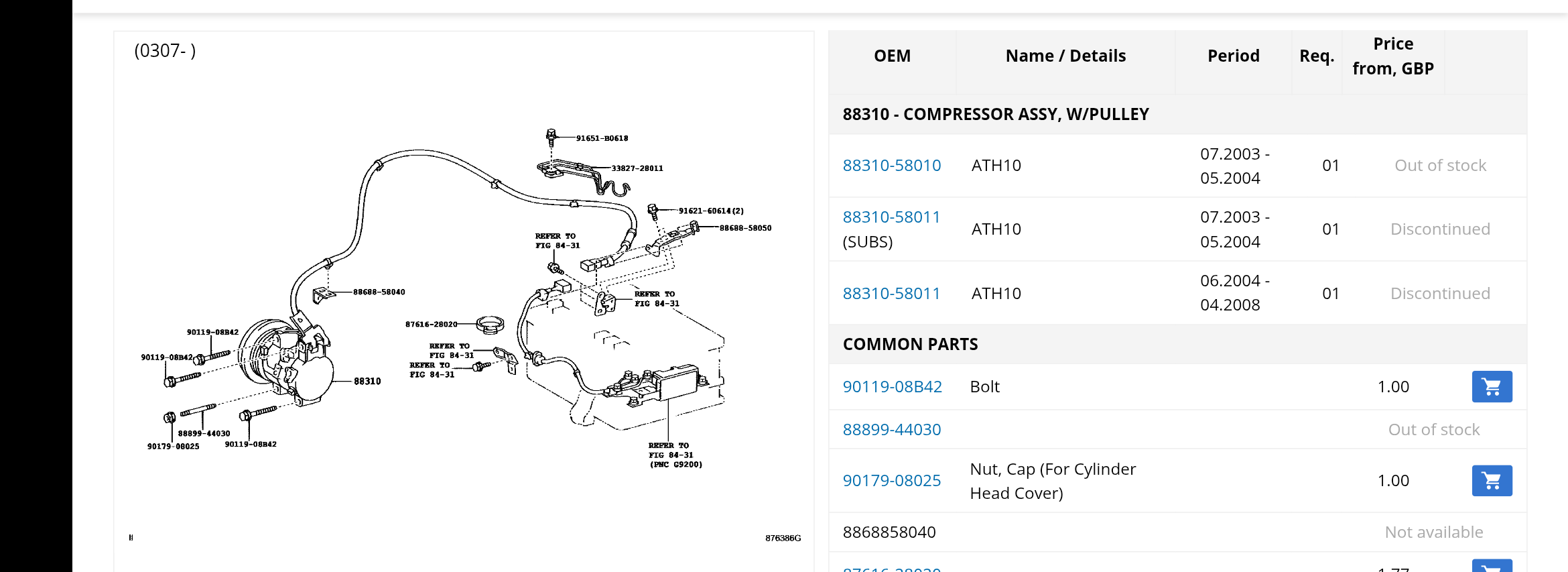
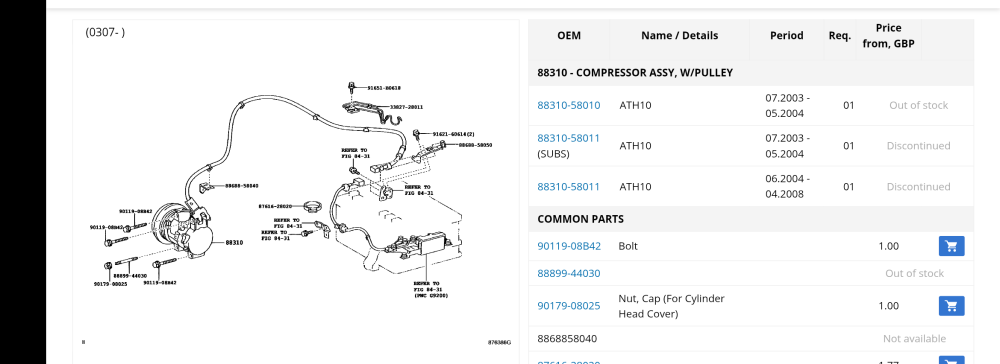
@Gamith your picture is for the non hybrid ANH10, the hybrid ATH10 uses the 88310-58010 or 88310-58011 - see picture. Amayama say it's no longer available from Toyota. I think the best bet is from a scrapyard vehicle. Check eBay (also for people breaking hybrids) and also ZenMarket for getting a used one from Japan.
-
That says it also fits the MCR30W and MCR40W versions of the Estima - that's 2000 to 2006. Maybe check eBay for Estima parts? Or look there for somebody breaking one and message them?
-
My van is full of junk and I'm away at the moment so I can't measure it easily, but I do know it's 2.44m from the back of the front seats to the tailgate. So assuming everything is flat and you are up to 2m tall there isn't a ton of extra space. If you are shorter then I think you may be able to slide the rear seat forward to create some more space, or keep it in the seated position which eats about 20cm but gives you a seat back behind which you can stash stuff. Those with rear conversions can confirm but I expect they take about 30-40cm which still leaves enough for the sleeping area. Also, I'm not sure if there are versions with electric middle seats which don't have the solid sides. I would probably aim for manual middle seats in case the electric ones are less flexible.
-
The 7 seater version with folding armrests can also be arranged into a similar lie flat layout. You have to remove the head rests from the second row before folding the seats. It's still quite lumpy so you want a mattress on top, but it's usable without any permanent modifications. You can also just fold one side, so you could have a single bed plus a seated/cargo section. The 7 seater with solid plastic armrests won't do it, I think.
-
I would look on eBay. If you search for "Alphard (breaking,braking)" (some people can't spell...) you may find a few people listing parts from their car for sale (often as '99p, this listing is for one wheel nut'). If you find the right car, message them and ask how much for the bumper. Be prepared to collect, as bumpers are awkward to ship. If doing the sale via eBay, the user will typically create a special listing for the parts you requested which you can 'buy it now'. Some professional breakers list and photograph every part, but this is a way of doing it without having to list thousands of parts. If you don't find anything there, create a saved search and enable email notifications and you'll get a daily email with search matches.
-
It's also fitted to a number of Lotus models. So just possibly there might be a Lotus specialist near you. I don't know whether they will expect you to pay Lotus prices however!
-
See here: https://www.amayama.com/en/genuine-catalogs/epc/toyota-japan/alphard/ANH10W/35721/body/7454 (Search on your frame number to confirm the exact model, then go to 7454 Battery Carrier) Amayama will ship them from Japan, but you could also try calling your local Toyota dealer with the part numbers.
-
Have a look at MOULDING. FLOOR CARPET: https://www.amayama.com/en/genuine-catalogs/epc/toyota-japan/alphard/ANH20W/40513/body/5854 That's for a random car - first search for your frame no. (ANH20-xxxxxxx) then go to 5854 FLOOR MAT AND SILENCER PAD. The suffix on the end of the part number (-B0, -C0, etc) is the colour. I'm not sure what Beige counts as, but maybe your frame number will come up with the right colour? Edit: maybe '-A0 SHELL' is beige?
-
42601C is the index number in the parts list, not the part number. The numbers listed underneath (90942-010xx) are the part numbers - copy the text into Google Translate to get what the Japanese says to work out the differences. Looks like there are different versions pre and post 2005 and based on the different kinds/sizes of wheels. If you start by putting your frame number (ANH10-xxxxxxx) into the search box of Amayama it'll show the parts for your specific trim level, although it doesn't always know about factory options. (I would also check your type A/B/C against the picture, as it's possible it has different wheel than factory) Although if you aren't fussy about design there are presumably also generic ones which will fit.
-
Before attacking the suspension, have you checked the steering motor damper? The parts are £20 on eBay and fixed my clonking noise (especially bad at low speed, eg over cobbles). Mine had been changed at 73k km and needed doing again at 160k. Search YouTube for 'Alphard kok kok steering noise' for some examples. It took me a couple of hours to do, the main awkwardness was the column pivots on a single bolt and getting it lined up was annoying - and I needed a universal joint socket to get access to drive it.
-
Nippon Autospares in Derby has some: https://nipponautospares.com/search?q=deflector&at%5B0%5D%5Bname%5D=Make&at%5B0%5D%5Bvalue_name%5D=Toyota but looks like only the right rear and right front (I think, it's labelled as right rear but has a sloping part that I think is for the front RH door). You could ask if they might be getting any more in?
-
Now I'm at a computer, a few more links: Random Aliexpress seller of the dongle (or search for Tactrix and pick one with a clear plug with gold pins) Tactrix Openport v2.0 drivers Techstream v18 download (don't run the 'patch') VM with Techstream preinstalled, see IH8MUD forum posting above. When I installed Techstream I set the region to 'Japan' (you can keep it in English) so it can talk to Japanese vehicles.
-
I'm using a Tactrix Openport clone with Techstream, which is the tool Toyota dealers used before they switched to a fully online system. Cost about $20. Techstream is usually sold with a 'mini VCI' cable which is a knockoff of the XHorse Mini VCI cable. Trouble is the hardware isn't very stable and the hacked drivers cause problems. With Tactrix (who have stopped selling genuine cables so only the clones remain) there are good and bad clones: https://blog.obdii365.com/2022/03/23/how-to-choose-the-right-clone-tactrix-openport-2-0-j2534/ (that's a Chinese seller of OBD stuff, the articles are plagiarized from various forum posts across the internet. Also the HTTPS certificate has expired. Don't buy anything from there but the article is still useful. I bought mine secondhand on eBay but there are plenty of new clones on AliExpress in the $20 ballpark) I set up a dedicated old laptop running Windows 7 32-bit, although Windows 10 works fine and I think XP does too. It needs to be 32 bit as the J2534 passthrough API for apps to talk to the driver is only specified for 32 bit Windows. I disabled networking on this laptop to avoid any update troubles and copied all files via USB stick. I installed the Tactrix drivers, then a fresh copy of Techstream (various sites offer it for download, I'm using v18 which is the last offline version from ~2023), which needed an activation code. I found a way to generate those (message me if you want details). You also need to select the Tactrix J2534 driver in settings. You can get a pre-installed pre-activated virtual machine with Techstream: https://forum.ih8mud.com/threads/how-to-techstream-in-5-minutes.1034923/ which might be easier - just add the Tactrix drivers. You also don't need a dedicated machine - any modern system should be able to run it. That's fine for reading and clearing trouble codes, but as I'm doing more complicated procedures I wanted it to be running natively. Now it's set up it's running very well.
-
This came up in my saved searches feed: https://www.i-bidder.com/en-gb/auction-catalogues/anglia-car-auctions/catalogue-id-anglia1-10091/lot-8940b52d-996c-4956-a4e3-b4a600fe3efa Anglia Car Auctions are usually more of a 'budget' car auction (I'd guess average age about 10 years old) and imports don't tend to come up very often, so perhaps the usual dealers won't be interested? Recently there was an Estima that went through for £2800 which was good value, so this could be a bargain for someone?
-
I can't comment on this dealer, but I found a similar vibe from a northern 'car supermarket' type place. The business model seems to be that they buy a lot of stock from Japanese auction, stick it on the boat, then do almost no prep when they reach the UK. They clean the cars and put them in their giant car park showroom where they... sit. Then when people buy them they find the issues that were there all along, and the dealer brushes them off fixing them (even though they are legally obliged to address them). They were even convicted of this in court. It seems like this one has sat for a year (if the odometer on the ad is km, when converted to miles it's 200 higher than the April 2025 mileage on the MOT), which not good especially for the hybrid. It might have been fresh off the boat when the advert was written, but it's more of a stale import now. There may also be some reason why it's not sold - seems plausible that a few people test drove it and walked away. Always do a CarVX before you go to inspect the car and get Google to translate the auction sheet. I use autoref.eu to convert number plates to VINs/frame numbers (5 free searches on a free account) which you can then feed to CarVX. I'd be especially checking the grade on the auction sheet and the odometer records as it's quite low for something at this price point. Maybe it's good stock that's been sitting around and reduced to clear or... maybe there's something we don't know about it.
-
It looks aftermarket - if it was factory I'd have expected a Toyota part number on it. I wonder if it has a 'ghost' type immobiliser on it - with those there's typically something secret you need to do like a button to press or whatever, otherwise the car won't start. Do you have to do anything like that? This box would be the part that detects that button press. I've seen (on a Range Rover on YT) ones where there's a box in the cabin that talks to a receiver under the fusebox which surreptitiously disconnects the fuel relay - engine turns over but won't start without the secret handshake.
-
Generally the Toyota hybrids are very reliable - Priuses are good for 350k miles. The 10 series has an issue with the inverter cooling pump (inverter overheats which damages the IGBTs), but is that a problem with the 20 series? My Gen2 Prius has never had it changed and it's at 175k miles. The one issue with the hybrid batteries is they don't like heat. In the 20 series (and the Estima) the battery is cooped up in the centre console with only a small fan at the base of the rear. Especially in hot climates like southern Japan, Malaysia and Singapore the batteries can get hot, and the fan isn't that great at cooling them. Also, if that fan gets blocked or clogged then it can reduce its cooling ability and the battery can overheat. Another reason why you should always run the aircon in hot weather. Typically it's the cells in the middle that suffer as they are the least well cooled. I have 3 bad modules on the upper bank (each module is 12 NiMH cells in the upper bank and 8 cells on the lower) so I'm planning to replace them and refurbish the rest when I've sorted some other jobs. For now it's still drivable but with fuel economy about the same as the petrol 2.4. I only get the fault code showing if I let the battery become over discharged - just let the engine run for a minute before turning off and it'll leave some charge in it. If you can get to London there are quite a few garages who will refurbish batteries - the battery is very similar to the 2006-19 Estima, and the hybrids of those are popular as London minicabs. Search eBay for 'Estima hybrid battery' and you'll find them.
-
I tend to be a bit wary of these paid unlock services - they are often somebody who downloaded an unlock generator from the internet and is charging $20 a time just to type some numbers in. On that vein I went looking for the unlock generator and I found this: ERC Calculator - トヨタ純正ナビ ロック解除コード計算機トヨタ・レクサス純正カーナビのERCコードからロック解除コードを無料で計算。機種別(NHDT・NHDN・NHZT・NHZN・NSZT・NSZN)の操作手順付き。 which seems to do a number of stock radios - I think mine is a NHZN. Source code is also available: https://github.com/cyrus07424/ercCalculator Not tried it as my unlock code has already been set to 0000. Perhaps someone can give it a go?
-
Last time I went to a festival-in-a-field, the local mobile network had signal but was completely saturated because it wasn't designed for XX thousand people showing up at this rural location. That's a different use case from regular camping where there's few other people about. Might be worth looking at Starlink. They keep changing the prices and terms but I think on some of the packages you can switch it on and off - ie don't pay the monthly fee when you don't need it.
-
Looks like the eBay links my search found are sold out: https://www.ebay.co.uk/itm/116129329727 https://www.ebay.com/itm/205946045739 https://www.ebay.co.uk/itm/205815273768 But there are some 44510-58011: https://www.ebay.co.uk/itm/389707272592 https://www.ebay.co.uk/itm/256274497133
-
T just means Toyota on dealer invoices. If I search for 44050-58011 and 44510-58011 I find used ones. Amayama says they have stock of new 44050-58011 for $1341.10 but you'd need to request a shipping quote (I'd guess about £50), and pay 20% VAT on the total once that parcel lands in the UK. Put your chassis number into Amayama to confirm the right part, as there are three for the 10 series depending on production date. Can you OBD scan it and see if it's raising any brake related fault codes? They will likely indicate what problems the system is reporting.